HUMAN
HUMAN is a project designed to support efforts toward a more person-centered and inclusive healthcare system. The project is co-funded by the EU under the Interreg Europe program and will run for four years, from 2025 to 2029. Participants come from twelve different countries in Europe. In addition to municipalities, businesses and universities are also represented. The municipality of Härnösand is the only Swedish participant in HUMAN.
The Project
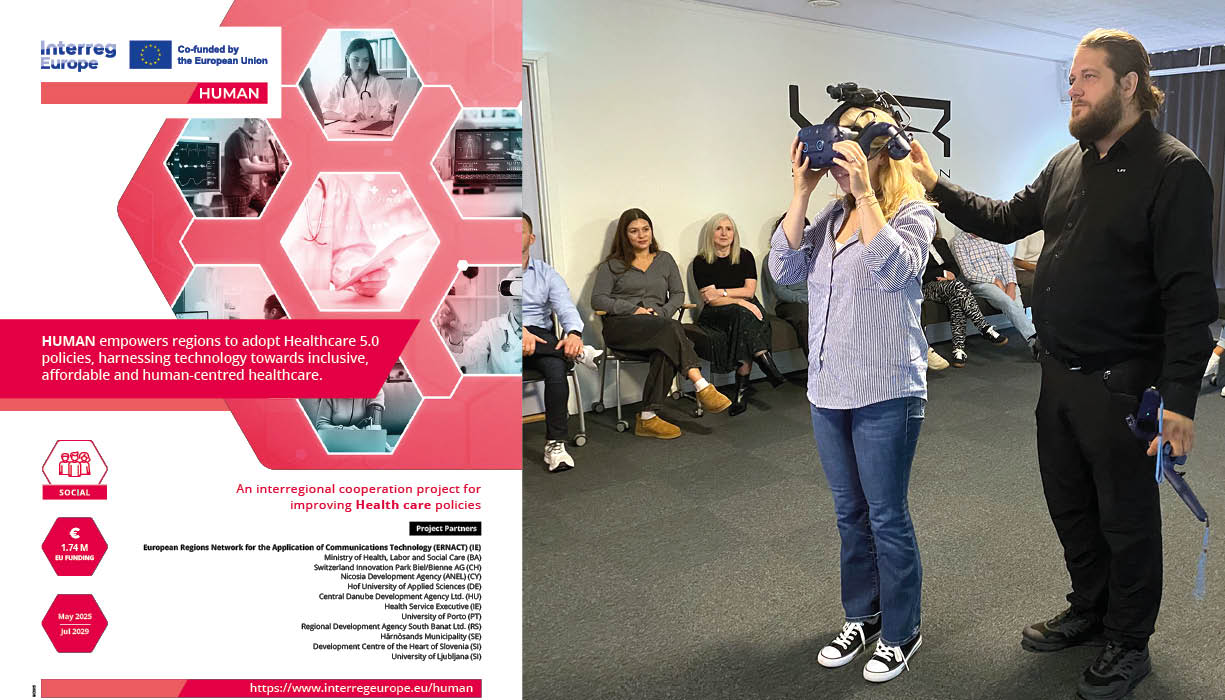
HUMAN is a European collaborative project co-funded by the European Union through the Interreg Europe program. The project supports the transition to Healthcare 5.0, where technology and digital innovation are used to create a more people-centered, inclusive, accessible, and affordable healthcare system.
Through interregional learning and the exchange of best practices, the project partners are working to improve policies that support this transition. The focus is on ensuring that digital developments meet people’s needs and help reduce inequalities in access to care.
Goals and Focus
People-centered care: The project aims to contribute to a more inclusive and accessible health care system, including from an economic perspective.
Digital Transformation: New technology and digital solutions will help improve efficiency in healthcare.
Reduced inequalities: The pandemic highlighted significant differences in digital maturity within healthcare across European regions. Through the exchange of experiences, the project works to address these challenges.
Within the framework of HUMAN, the Municipality of Härnösand is sharing experiences from two VR-based training programs it has developed. One focuses on a person-centered and rehabilitative approach. The other addresses understanding and managing behavioral and psychological symptoms of dementia (BPSD) and was developed in collaboration with Mid Sweden University. Both training programs combine theory, practical training in a VR environment, and group reflection to strengthen staff knowledge and skills.
The municipality has also established an assessment and intervention team that, through early, preventive, and rehabilitative measures, aims to enhance older adults’ sense of security, independence, and ability to continue living at home. The team’s approach has been recognized by Interreg Europe as an “expert-approved” best practice.
Project Meeting in Härnösand
A central part of HUMAN is the exchange of experiences through visits to the participating project partners. In September 2026, the municipality of Härnösand hosted one of these project meetings.
The meeting in Härnösand focused on digital health literacy, inclusion, and the future of learning. Discussions centered on how digital solutions can make health and social care more accessible and how we can ensure that people have the knowledge and support needed to benefit from them. Special attention was given to older adults and other groups at risk of digital exclusion.
Stakeholder Meeting 28/10/2026
Digital access is not the same as digital participation. So how can we help more people understand and use digital services for their health? And how do we approach implementation, long-term use, and follow-up to ensure that digitalization and welfare technology make a difference in everyday life? These were some of the questions raised when 21 participants gathered in Härnösand on October 28 for the fourth stakeholder meeting within the HUMAN project.
Representatives from Härnösand Municipality participated, representing healthcare and social services, IT and digitalization, Härnösand public library, the municipality’s Service Center, the VR studio, and business development.
The meeting opened with a presentation by Professor Susanne Iwarsson from Lund University on aging, digitalization, and care. Jennie Olofsson, Mats Gradin, and Zarah Bussman shared their experiences from HUMAN’s interregional meeting in Härnösand.
Afterward, business development specialists Per Mattson and Isabell Karlsson presented the municipality’s ongoing work on digitalization and assistive technology.
Participants discussed how to provide digital support to family members, opportunities for increased collaboration, and how to track the benefits of digitalization and welfare technology.
Projektledare
Zarah Bussman
070-340 03 61
zarah.bussman@harnosand.se
Jens Hallner
070-400 96 38
jens.hallner@harnosand.se
Jennie Olofsson
070-301 18 31
jennie.olofsson@harnosand.se
Läs mer
Huvudprojektsida:
www.interregeurope.eu/human External link.
HUMAN på LinkedIn:
www.linkedin.com/company/humanproject External link.
HUMAN på Facebook:
www.facebook.com/interreghuman External link.
Kontakt
För mer information kontakta:
Zarah Bussman
070-340 03 61
zarah.bussman@harnosand.se